
Highest protein snacks · ranked three ways. Highest by what?
Per serving, per 100 calories or per ounce. Tap one. The order changes.
Published by Chicken Butt Jerky. We make chicken jerky. This is general information, not medical advice. Last checked Nov 26, 2026.
Ranked by protein per 100 calories: 24 snacks. Grams of protein for every 100 calories: how much of the food is protein.
| # | Snack | Protein per 100 cal | Protein a serving | Protein per oz | Serving | Calories | Sodium, mg | Sugars, g | Fridge | The catch |
|---|---|---|---|---|---|---|---|---|---|---|
| 1 | Tuna, canned in water | 18 g per 100 cal | 20 g a serving | 7 g per oz | Serving 85 g, drained | 109 cal | 320 mg sodium | 0 g sugar | Fridge: No | A can opener and a fork. Opened, it goes in the fridge. |
| 2 | Greek yogurt, plain, nonfat | 17 g per 100 cal | 17 g a serving | 3 g per oz | Serving 170 g | 100 cal | 61 mg sodium | 6 g sugar | Fridge: Yes | Plain means sour. Fruit or honey adds sugar the row does not show. |
| 3 | Chicken jerky We make this one | 16 g per 100 cal | 13 g a serving | 13 g per oz | Serving 1 oz (28 g) | 80 cal | 630-640 mg sodium | 0 g sugar | Fridge: No | Salty: 630-640 mg sodium a serving. See the six flavors |
| 4 | Turkey breast slices | 14 g per 100 cal | 8 g a serving | 4 g per oz | Serving 55 g | 58 cal | 494 mg sodium | 1 g sugar | Fridge: Yes | Salty for its size. Opened, use it within 3 to 5 days. |
| 5 | Cottage cheese, 2% | 13 g per 100 cal | 11 g a serving | 3 g per oz | Serving 110 g | 89 cal | 339 mg sodium | 4 g sugar | Fridge: Yes | Needs a fridge and a spoon. |
| 6 | Sardines, canned in oil | 12 g per 100 cal | 21 g a serving | 7 g per oz | Serving 85 g, drained | 177 cal | 261 mg sodium | 0 g sugar | Fridge: No | The smell. Your coworkers will know. |
| 7 | A protein shake, ready to drink (generic) | 11 g per 100 cal | 17 g a serving | 2 g per oz | Serving 1 cup (256 g) | 156 cal | 184 mg sodium | 2 g sugar | Fridge: No | A USDA survey entry for this kind of shake. Your carton is the number that counts. |
| 8 | Edamame | 10 g per 100 cal | 10 g a serving | 3 g per oz | Serving 85 g | 103 cal | 5 mg sodium | 2 g sugar | Fridge: Yes | Cooked from frozen. Unsalted as listed; salt is up to you. |
| 9 | Mozzarella, part skim (a cheese stick) | 10 g per 100 cal | 7 g a serving | 7 g per oz | Serving 30 g | 76 cal | 186 mg sodium | 0 g sugar | Fridge: Yes | Small, and it needs a fridge. |
| 10 | Hard-boiled egg | 8 g per 100 cal | 6 g a serving | 4 g per oz | Serving 1 large egg (50 g) | 78 cal | 62 mg sodium | 1 g sugar | Fridge: Yes | Keeps about a week in the fridge once cooked. |
| 11 | Beef jerky, chopped and formed | 8 g per 100 cal | 10 g a serving | 9 g per oz | Serving 30 g | 123 cal | 534 mg sodium | 3 g sugar | Fridge: No | Salty, and sweeter than most rows: read the label. |
| 12 | Cheddar | 6 g per 100 cal | 7 g a serving | 7 g per oz | Serving 30 g | 123 cal | 193 mg sodium | 0 g sugar | Fridge: Yes | Same protein as mozzarella, about 50 more calories. |
| 13 | A protein bar (generic) | 6 g per 100 cal | 9 g a serving | 6 g per oz | Serving 40 g | 154 cal | 128 mg sodium | 12 g sugar | Fridge: No | A USDA survey entry for this kind of bar. Your wrapper is the number that counts. |
| 14 | Pumpkin seeds, roasted, salted | 5 g per 100 cal | 9 g a serving | 8 g per oz | Serving 30 g | 172 cal | 77 mg sodium | 0 g sugar | Fridge: No | Kernels, not whole seeds in the shell. |
| 15 | Peanuts, dry roasted, salted | 4 g per 100 cal | 7 g a serving | 7 g per oz | Serving 30 g | 176 cal | 123 mg sodium | 1 g sugar | Fridge: No | Easy to eat three servings without noticing. |
| 16 | Peanut butter, smooth, salted | 4 g per 100 cal | 7 g a serving | 6 g per oz | Serving 2 tbsp (32 g) | 191 cal | 136 mg sodium | 3 g sugar | Fridge: No | Needs a spoon, or something to spread it on. |
| 17 | Pistachios, roasted, salted | 4 g per 100 cal | 6 g a serving | 6 g per oz | Serving 30 g | 171 cal | 128 mg sodium | 2 g sugar | Fridge: No | Shelled weight. The shells slow you down, which some people like. |
| 18 | Almonds | 4 g per 100 cal | 6 g a serving | 6 g per oz | Serving 30 g | 174 cal | 0 mg sodium | 1 g sugar | Fridge: No | Strong per ounce, weak per calorie. |
| 19 | Popcorn, air-popped | 3 g per 100 cal | 4 g a serving | 4 g per oz | Serving 30 g | 116 cal | 2 mg sodium | 0 g sugar | Fridge: No | Plain, no butter. Butter changes every number. |
| 20 | Hummus | 3 g per 100 cal | 2 g a serving | 2 g per oz | Serving 2 tbsp (30 g) | 71 cal | 128 mg sodium | 0 g sugar | Fridge: Yes | A dip, so it rides with whatever you dip in it. |
| 21 | Pretzels, hard, salted | 3 g per 100 cal | 3 g a serving | 3 g per oz | Serving 30 g | 115 cal | 372 mg sodium | 1 g sugar | Fridge: No | Salty, and little protein for the calories. |
| 22 | Banana | 1 g per 100 cal | 2 g a serving | <1 g per oz | Serving 140 g | 125 cal | 1 mg sodium | 17 g sugar | Fridge: No | Almost no protein. It comes in its own wrapper. |
| 23 | Potato chips, salted | 1 g per 100 cal | 2 g a serving | 2 g per oz | Serving 30 g | 160 cal | 158 mg sodium | 0 g sugar | Fridge: No | Here so the table has a bottom. |
| 24 | Apple | 1 g per 100 cal | <1 g a serving | <1 g per oz | Serving 140 g | 73 cal | 1 mg sodium | 15 g sugar | Fridge: No | Almost no protein. Sweet, crunchy, no wrapper. |
Protein in grams. USDA numbers at the federal reference serving; ours from its label. How we got them.
Why the order keeps changing.
Big servings top "per serving". Dry foods top "per ounce". "Per 100 calories" shows how much of a food is protein, so the table opens there.
Show the arithmetic
One row, worked: tuna canned in water. USDA lists 23.6 g of protein and 128 calories in 100 g. The reference serving is 85 g, so 23.6 × 0.85 = 20.1 g of protein and 128 × 0.85 = 109 calories. Per 100 calories: 20.1 ÷ 109 × 100 = 18 g. Per ounce (28.35 g): 23.6 × 0.2835 = 6.7 g. Tuna leads per 100 calories and sits mid-table per ounce, where dry foods pull ahead.
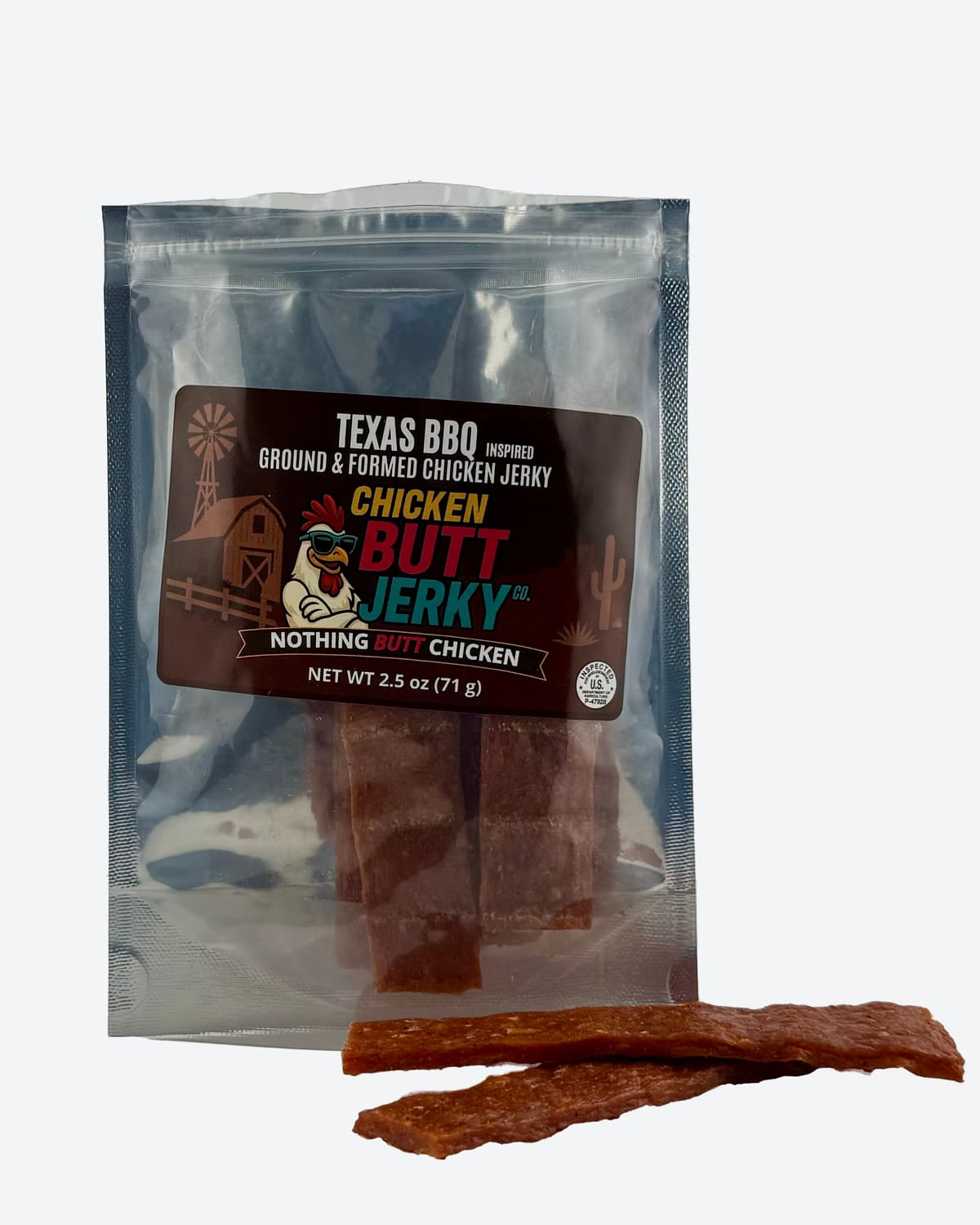
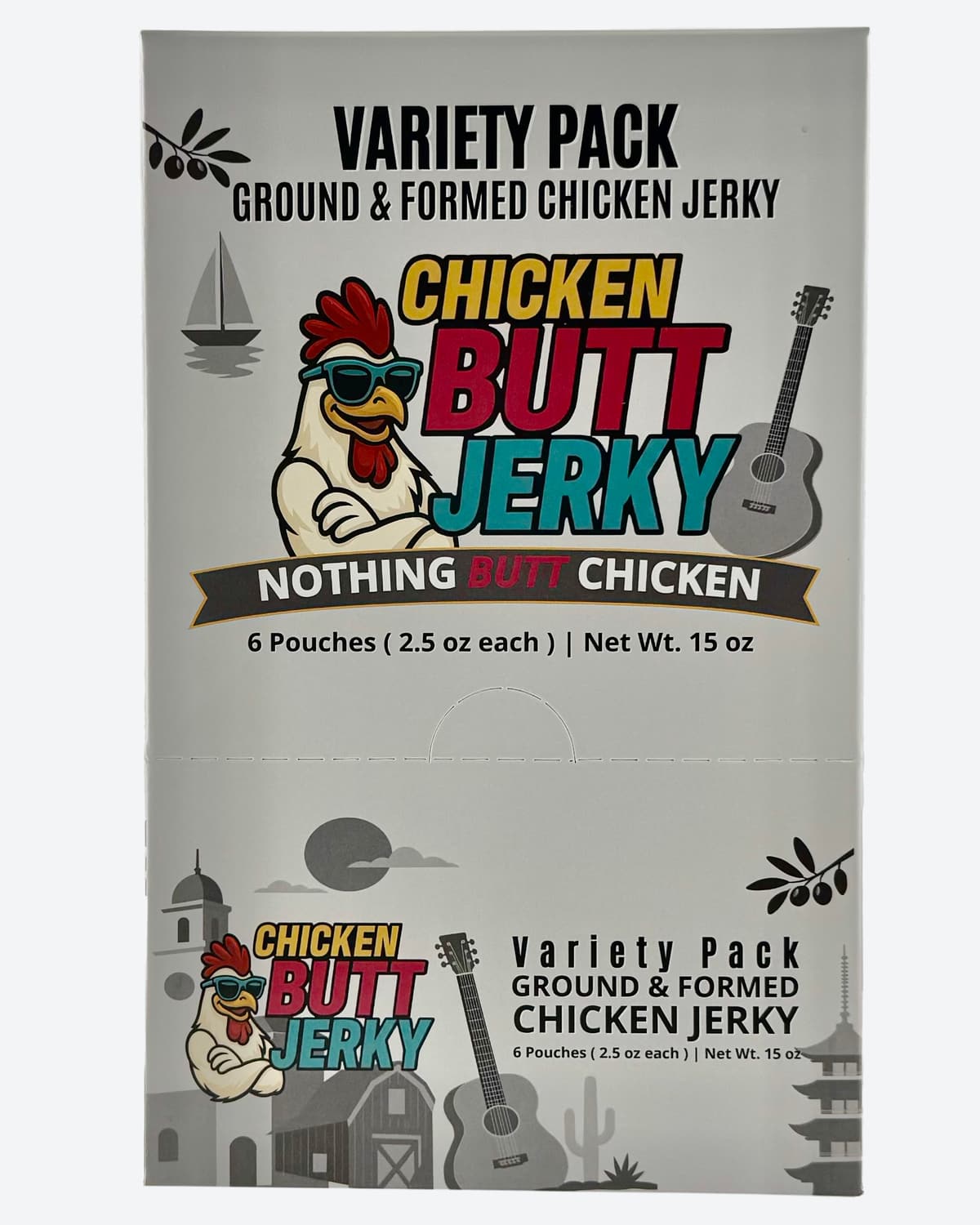
We make this one
The row with our name on it.
Chicken thigh and breast, ground, formed and slow dried. Per 1 oz serving: 13 g protein, 80 calories, 0 g sugar. And 630-640 mg sodium. That is the trade.
Buy 2 Get 1 Free on 6-Packs
$59.94 for six pouches, one of each flavor
Free shipping from $55, lower 48 and DC.
Ghost of Tokyo contains sesame. Old Jaffa contains MSG. Produced on shared equipment with milk, eggs, tree nuts, peanuts, wheat and soy.
Heat and flavors
- Heat 0-3 Mixed, all six flavors (0-3)
One 2.5 oz pouch of each of the six flavors, from no heat (Old Jaffa, Texas BBQ and El Paso) to heat 3 of 3 (Ghost of Tokyo). Per pouch, 33-34 g protein and 200-210 calories.
Two rows, two places.
-

No fridge until opened
In a gym bag.
Back to the tableA protein shake and a banana: 18 g protein, 281 calories.
-

No fridge until opened
In a car.
One Texas BBQ pouchA serving of our chicken jerky and an apple: 13 g protein, 153 calories. Both ride in the console.
How we got the numbers
Every food but ours comes from USDA FoodData Central, read on Nov 26, 2026. Each row's source is in the next fold, with its FoodData Central id and the name USDA gives it, shortened where the table says so. FoodData Central lists nutrients per 100 g; the table multiplies by the serving's grams.
The serving is the federal reference amount for that kind of food: the amount the FDA and USDA use to set the serving on a Nutrition Facts label (21 CFR 101.12, and 9 CFR 317.312 and 381.412 for meat and poultry). For example, 30 g for nuts, seeds, chips and cheese, 85 g for canned fish, 170 g for yogurt. Where the reference is a spoon or a cup, the grams come from FoodData Central's own measure for that food.
Our row comes from our printed label: 13 g protein, 80 calories, 630-640 mg sodium and 0 g sugar per 1 oz (28 g) serving. Label numbers are rounded by the label rules, while the USDA rows use unrounded averages, so our row is less exact than the others. Its "per ounce" is the label's 1 oz serving as printed. Sodium is printed as a range, so the table ranks and filters on 640 mg.
The arithmetic. Protein per 100 calories is protein ÷ calories × 100. Protein per ounce is protein per 100 g × 0.2835. Every number is rounded to a whole number at the end; less than half a gram of protein shows as "<1". The sort uses the unrounded numbers, and ties go in alphabetical order.
Fridge reads "Yes" for foods sold from a refrigerated case and for cooked eggs. It reads "No" for jerky and canned foods, shelf stable until opened, and for dried and roasted foods sold from the shelf. For whole fruit, peanut butter and the generic shake, "No" is our call, not a cited rule. Opened cans and pouches go in the fridge.
What this page does not do. It ranks snacks by numbers. It does not say how much protein anyone needs. Food labels count protein against a Daily Value of 50 g; your doctor or a registered dietitian can tell you what fits you.
Numbers last checked Nov 26, 2026. We read the USDA entries again each January.
Every number's source
Per 100 g as FoodData Central lists it. The FDC id is the food's record number in FoodData Central.
| Snack | FDC id | USDA name | Per 100 g | Serving used |
|---|---|---|---|---|
| Hard-boiled egg | 173424 | Egg, whole, cooked, hard-boiled (SR Legacy) | 155 cal, 12.6 g protein, 124 mg sodium, 1.12 g sugars | RACC eggs, 50 g (21 CFR 101.12) |
| Cottage cheese, 2% | 172182 | Cheese, cottage, lowfat, 2% milkfat (SR Legacy) | 81 cal, 10.4 g protein, 308 mg sodium, 4 g sugars | RACC cottage cheese, 110 g (21 CFR 101.12) |
| Greek yogurt, plain, nonfat | 170894 | Yogurt, Greek, plain, nonfat (Includes foods for USDA's Food Distribution Program) (SR Legacy) | 59 cal, 10.2 g protein, 36 mg sodium, 3.24 g sugars | RACC yogurt, 170 g (21 CFR 101.12) |
| Mozzarella, part skim (a cheese stick) | 170847 | Cheese, mozzarella, part skim milk (SR Legacy) | 254 cal, 24.3 g protein, 619 mg sodium, 1.13 g sugars | RACC cheese, all others, 30 g (21 CFR 101.12) |
| Cheddar | 170899 | Cheese, cheddar, sharp, sliced (SR Legacy) | 410 cal, 24.2 g protein, 644 mg sodium, 0.27 g sugars | RACC cheese, all others, 30 g (21 CFR 101.12) |
| Edamame | 168411 | Edamame, frozen, prepared (SR Legacy) | 121 cal, 11.9 g protein, 6 mg sodium, 2.18 g sugars | RACC vegetables, fresh or frozen, 85 g (21 CFR 101.12) |
| Peanuts, dry roasted, salted | 174262 | Peanuts, all types, dry-roasted, with salt (SR Legacy) | 587 cal, 24.4 g protein, 410 mg sodium, 4.9 g sugars | RACC nuts and seeds, 30 g (21 CFR 101.12) |
| Almonds | 170567 | Nuts, almonds (SR Legacy) | 579 cal, 21.2 g protein, 1 mg sodium, 4.35 g sugars | RACC nuts and seeds, 30 g (21 CFR 101.12) |
| Pistachios, roasted, salted | 169426 | Nuts, pistachio nuts, dry roasted, with salt added (SR Legacy) | 569 cal, 21 g protein, 428 mg sodium, 7.74 g sugars | RACC nuts and seeds, 30 g (21 CFR 101.12) |
| Pumpkin seeds, roasted, salted | 169415 | Seeds, pumpkin and squash seed kernels, roasted, with salt added (SR Legacy) | 574 cal, 29.8 g protein, 256 mg sodium, 1.29 g sugars | RACC nuts and seeds, 30 g (21 CFR 101.12) |
| Peanut butter, smooth, salted | 174266 | Peanut butter, smooth style, with salt (Includes foods for USDA's Food Distribution Program) (SR Legacy) | 598 cal, 22.2 g protein, 426 mg sodium, 10.5 g sugars | RACC nut and seed butters, 2 tbsp (21 CFR 101.12); FDC measure 2 tbsp = 32 g |
| Hummus | 174289 | Hummus, commercial (SR Legacy) | 237 cal, 7.78 g protein, 426 mg sodium, 0.62 g sugars | RACC dips, 2 tbsp (21 CFR 101.12); FDC measure 1 tbsp = 15 g |
| Tuna, canned in water | 175158 | Fish, tuna, white, canned in water, drained solids (SR Legacy) | 128 cal, 23.6 g protein, 377 mg sodium, 0 g sugars | RACC fish, canned, 85 g (21 CFR 101.12) |
| Sardines, canned in oil | 175139 | Fish, sardine, Atlantic, canned in oil, drained solids with bone (SR Legacy) | 208 cal, 24.6 g protein, 307 mg sodium, 0 g sugars | RACC fish, canned, 85 g (21 CFR 101.12) |
| Turkey breast slices | 172941 | Turkey breast, sliced, prepackaged (SR Legacy) | 106 cal, 14.8 g protein, 898 mg sodium, 0.91 g sugars | RACC poultry luncheon products, 55 g (9 CFR 381.412) |
| Beef jerky, chopped and formed | 167536 | Snacks, beef jerky, chopped and formed (SR Legacy) | 410 cal, 33.2 g protein, 1780 mg sodium, 9 g sugars | RACC dried meat, e.g. jerky, 30 g (9 CFR 317.312) |
| Chicken jerky | Printed label | Label: 1 oz (28 g) serving | 80 cal, 13 g protein, 630-640 mg sodium, 0 g sugar a serving | the printed label (data/brand.yaml) |
| A protein bar (generic) | 2708127 | Nutrition bar, not further specified (name shortened; USDA survey food code 53729000) (Survey (FNDDS)) | 386 cal, 22.36 g protein, 320 mg sodium, 29.31 g sugars | RACC grain-based bars, 40 g (21 CFR 101.12) |
| A protein shake, ready to drink (generic) | 2710726 | Nutritional drink or shake, high protein, ready-to-drink, NFS (Survey (FNDDS)) | 61 cal, 6.59 g protein, 72 mg sodium, 0.6 g sugars | RACC shakes and milk-based drinks, 240 mL (21 CFR 101.12); FDC portion 1 cup = 256 g |
| Popcorn, air-popped | 167959 | Snacks, popcorn, air-popped (SR Legacy) | 387 cal, 12.9 g protein, 8 mg sodium, 0.87 g sugars | RACC snacks, chips, pretzels, popcorn, 30 g (21 CFR 101.12) |
| Pretzels, hard, salted | 167555 | Snacks, pretzels, hard, plain, salted (SR Legacy) | 384 cal, 10 g protein, 1240 mg sodium, 2.21 g sugars | RACC snacks, chips, pretzels, popcorn, 30 g (21 CFR 101.12) |
| Potato chips, salted | 169677 | Snacks, potato chips, plain, salted (SR Legacy) | 532 cal, 6.39 g protein, 527 mg sodium, 0.33 g sugars | RACC snacks, chips, pretzels, popcorn, 30 g (21 CFR 101.12) |
| Apple | 171688 | Apples, raw, with skin (Includes foods for USDA's Food Distribution Program) (SR Legacy) | 52 cal, 0.26 g protein, 1 mg sodium, 10.4 g sugars | RACC fruits, fresh, 140 g (21 CFR 101.12) |
| Banana | 173944 | Bananas, raw (SR Legacy) | 89 cal, 1.09 g protein, 1 mg sodium, 12.2 g sugars | RACC fruits, fresh, 140 g (21 CFR 101.12) |
Questions people ask
Questions about protein snacks
Which snack has the most protein?
It depends on what you divide by. Per serving in this table: sardines, tuna and plain Greek yogurt. Per 100 calories: tuna, plain Greek yogurt and turkey slices. Per ounce: beef jerky, pumpkin seeds and sardines. We left our own row out of this answer: sort the table to see where it lands.
What does protein per 100 calories mean?
It is the grams of protein in a food divided by its calories, times 100. It lets you compare a cup of yogurt with a handful of nuts without arguing about serving sizes.
How much protein is in jerky?
USDA lists chopped and formed beef jerky at 33.2 g of protein per 100 g, about 10 g in a 30 g serving, with 534 mg of sodium in that serving. The chicken jerky we make has 13 g of protein per 1 oz serving on its label, with 630-640 mg of sodium.
Which protein snacks need no fridge?
In this table: nuts and seeds, peanut butter, canned tuna and sardines, jerky, the generic bar and shake, popcorn, pretzels, chips, apples and bananas. Cans, pouches and cartons go in the fridge once opened. USDA lists commercially packaged jerky at 12 months on the shelf.
Are protein snacks salty?
Some are. Per serving, the saltiest row in this table is the one we make: 630-640 mg of sodium per 1 oz serving. Beef jerky (534 mg), turkey slices (494 mg) and pretzels (372 mg) come next. A food label counts sodium against a Daily Value of 2,300 mg.
Sources (9)
Sources
- FoodData Central, USDA Agricultural Research Service
- 21 CFR 101.12, Reference amounts customarily consumed per eating occasion, Electronic Code of Federal Regulations
- 9 CFR 317.312, Reference amounts customarily consumed per eating occasion (meat products), Electronic Code of Federal Regulations
- 9 CFR 381.412, Reference amounts customarily consumed per eating occasion (poultry products), Electronic Code of Federal Regulations
- Daily Value on the Nutrition and Supplement Facts Labels, U.S. Food and Drug Administration
- How to Understand and Use the Nutrition Facts Label, U.S. Food and Drug Administration
- Shelf-Stable Food Safety, USDA Food Safety and Inspection Service
- Cold Food Storage Chart, FoodSafety.gov
- FAQ and nutrition facts, Chicken Butt Jerky
Photo credits: Karolina Grabowska (Pexels), Barbara Olsen (Pexels), Dextar Studio (Pexels).